







Advice

Choosing the Right Oil for Your Bakery

Learn the key differences between foodservice oils and discover which options are best suited to different cooking applications.

canol oil article image v2

Choosing the right cooking oil for your bakery

Oil can play several roles in a bakery kitchen. Depending on your range, you may need it for baking, frying, shallow frying, batters, savoury products or general food preparation.

The important question isn't simply "which oil is best?" It's which oil has the right characteristics for what you're making?

Oil choice can affect heat stability, flavour, fry life and the finished texture of food. Understanding those differences can help you narrow down the right option for your operation.
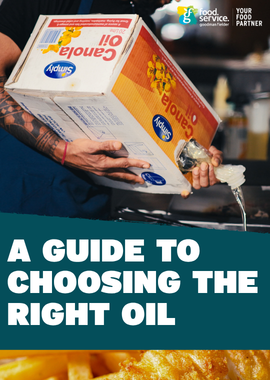
Download our practical guide to help you understand the key considerations and explore the best oil options for your bakery.


What makes oils perform differently?

One factor is the balance of saturated and unsaturated fats.

Saturated fats have strong heat stability, making them particularly useful under prolonged, continuous high-temperature frying conditions. Monounsaturated fats provide greater heat stability than polyunsaturated fats while remaining versatile across different cooking applications.

Polyunsaturated fats are less stable under prolonged heat and therefore better suited to lower-heat cooking or raw applications than more heat-stable fat profiles.

For a bakery, that means the right answer will depend heavily on whether you're primarily baking, preparing general menu items or running a fryer.


Foodservice oils to consider for your bakery

  • Canola oil
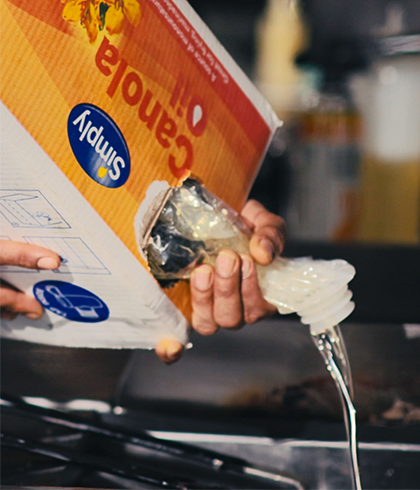
  • A particularly versatile option where an oil needs to cover different jobs in the bakery. Canola oil is suitable for baking as well as frying, shallow frying, sautéing, marinades and tempura. It has a neutral flavour and light mouthfeel, contains less than 10% saturated fat and has plant-based omega-3 content. Available in: 20L bag in box.
  • Cottonseed oil
    Cottonseed oil is a polyunsaturated oil suited to delicate, crisp frying. Its light, clean finish and minimal flavour impact make it appropriate for batters and tempura as well as deep frying. Available in: 20L bag in box.

  • Soya oil
    A practical multi-purpose option that can move between frying and general cooking tasks. Soya oil is suited to deep and shallow frying, sautéing, dressings, sauces, marinades and tempura batters. Its neutral flavour also makes it suitable for kitchens preparing a varied menu. Available in: 20L bag in box.

  • Rice bran oil
    Where prolonged high-temperature cooking is the priority, rice bran oil provides stronger thermal stability. It can be used for high-temperature cooking and deep frying with extended heat exposure. Available in: 15L bag in box. 

Oils and fats for bakery frying applications

If your bakery produces significant volumes of fried products, the demands placed on the oil change.

Long periods at high temperatures place greater emphasis on the oil's thermal and oxidative stability. Saturated fats offer stronger heat stability and longer fry life under prolonged, continuous high-temperature frying than unsaturated profiles. 

Fry Rite shortening is specifically designed for high-temperature, continuous frying operations. 

Simply Fry Oil is designed as a versatile frying oil, combining saturated and unsaturated oils for balanced heat stability, consistent frying performance and resistance to breakdown. 

Fryall Beef Tallow can be used for deep frying, pan frying and baking applications where its rich savoury flavour is appropriate.

Find the right oil for the job

Rather than choosing oil on a single characteristic, match it to your application.

Consider whether you need an oil primarily for baking and general cooking, a neutral oil that can work across the kitchen, or a frying oil designed to withstand more demanding operating conditions.

Download the Foodservice Oil Guide to compare the full range, applications and characteristics in one place. 


Bakery Oil Frequently Asked Questions