



Your Partner In Sustainability
Our Commitment
From recycled dairy packaging to 100% renewable electricity and a bold net zero emissions goal by 2050, we're working to reduce our impact while delivering the food and beverages New Zealand hospitality relies on.
We're a large New Zealand food company, and we take that responsibility seriously: improving efficiency across our supply chain, reducing waste, and playing our part in cutting emissions, because we feel it's both an opportunity and responsibility for our business.
Dairy packaging
Reducing plastic, one bottle at a time
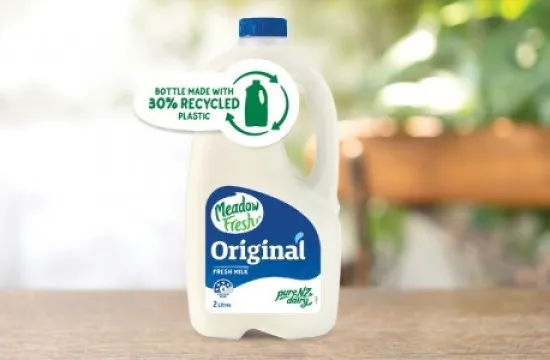
With over 9.5 million milk bottles produced every year, packaging presents a significant opportunity to reduce our environmental impact. Our milk bottles contain 30% recycled material, which means we're cutting the amount of new plastic used by around 250 tonnes a year.
We're continuing to look at ways to reduce the material used across our packaging more broadly, improve end-of-life solutions for our packaging materials and support a circular economy
Currently, 97.48% of our packaging is recyclable. We're continuing to evolve our approach to end of life, working to ensure our products are designed for recyclability through kerbside or drop-off collection. We're also continuing to evolve our design and material selection to consider environmental impact, and to respond to potential Extended Producer Responsibility (EPR) schemes.
How much virgin plastic is your business saving from landfill each year?
Our packaging partnerships
We're a member of several packaging partnerships supporting our sustainable packaging ambitions:

The soft plastics recycling scheme, supporting drop-off locations and the transportation of soft plastics for processing and recycling.

The lids and caps scheme, launched in 2024. This growing initiative aims to expand drop-off locations across New Zealand, giving consumers an interim recycling option while solutions for these plastics continue to evolve.

The food and beverage carton recycling scheme, a voluntary product stewardship programme launched in 2024 to support drop-off locations and end-of-life solutions.

Completed Sustainability Projects
- Meadowfresh Longburn Heat Pump For Secondary Hot Water: Our Meadowfresh Longburn site had identified an opportunity to utilise waste heat from the ammonia refrigeration system to generate hot water for site utilisation with the target to reduce Carbon Dioxide Equivalent by 1,200 Tons per year.
- Meadowfresh Christchurch Heat Pump For Hot Water: Meadowfresh Christchurch, like the Longburn site, identified an opportunity to recover waste heat from its chilling systems and upgrade it into usable hot water. The target reduction is 939 Tons of Carbon Dioxide Equivalent per year.
- Quality Bakers Hawkes Bay Heat Recovery: This heat recovery system utilises oven flue gas to heat water, which is then used in the bread prover to achieve and maintain the required operating temperature. The target reduction is 15% of site emissions.
- Quality Bakers Nelson Heat Recovery: Similarly to Quality Bakers Hawke’s Bay, Quality Bakers Nelson has implemented a system to recover waste heat from its natural gas-fired bread oven and is targeted to reduce site emissions by 15%.
- Quality Bakers Auckland Heat Recovery System: Quality Bakers Auckland has implemented a heat recovery system to capture and utilise waste heat from two large air compressors that would otherwise be lost. This is targeted to reduce emissions by 70 Tons of carbon dioxide equivalent per year.
Reducing waste, in our operations and beyond
Reducing waste is a key pillar of our sustainability strategy, across every part of our operations. That starts with the responsible use of local natural resources, and extends to how we support the wider industry.
We're a proud signatory of the Kai Commitment, New Zealand's national programme to reduce food waste across the industry. We're also currently part of a New Zealand-first project studying the link between food waste and methane emissions, working alongside WRAP, Eunomia and the Rainier Climate Group. Read more about our Kai Commitment work
We know New Zealanders are already doing great work tackling waste, and we want to keep supporting our customers in recycling, reusing and reducing waste, through practical tools and education, not just our own operations.
Working toward net zero
We're on our way to an ambitious net zero emissions goal by 2050, and 100% renewable electricity is already part of how we get there. We believe real progress happens when we work on this together, with our customers, our suppliers, and the wider New Zealand food industry.
Explore More
Read about our Kai Commitment partnership | Back to About Us