







Advice

How to choose cooking and frying oil for your restaurant

Compare foodservice oils for restaurant cooking and frying. Understand heat stability, fry life, flavour and applications to help choose the right oil.

canol oil article image v3

How to choose cooking and frying oil for your restaurant

Restaurant kitchens can ask very different things of an oil. One service might involve deep frying, sautéing and dressings, while another kitchen may have fryers operating under prolonged, high-temperature conditions. That means choosing oil starts with how your kitchen actually cooks. Heat stability, fry life, flavour neutrality and texture outcomes are key considerations. Fat profile can also help indicate how an oil will perform under heat

 

Download our practical guide to help you understand the key considerations and explore the best oil options for your restaurant.


How does fat profile affect frying performance?

Saturated fats have a structure that provides strong heat stability and longer fry life, particularly during prolonged, continuous high-heat frying.

Unsaturated fats include monounsaturated and polyunsaturated fats. Monounsaturated fats are more heat-stable than polyunsaturated fats and work across a broad range of cooking applications. Polyunsaturated fats break down faster under prolonged heat and are therefore better suited to lower-heat cooking or raw applications compared with more heat-stable fat profiles.

For restaurant operators, the practical approach is to prioritise performance requirements first, particularly stability, fry life and consistency, and then consider fat profile and nutritional characteristics alongside those requirements.


Which foodservice oil suits your restaurant?

  • Canola oil: for versatility across the kitchen
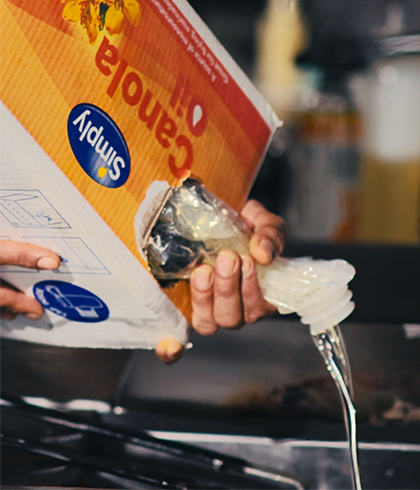
    Canola oil can be used for frying, shallow frying, stir-frying, sautéing, dressings, marinades, baking and tempura. It has a neutral flavour and light mouthfeel, contains less than 10% saturated fat and has plant-based omega-3 content. Available in: 20L bag in box. 

  • Cottonseed oil: for delicate, crisp frying
    Cottonseed oil has a light, clean finish and is suited to deep frying, batters and tempura where minimal oil flavour is a priority. It can also be used for dressings and mayonnaise. Available in: 20L bag in box. 

  • Soya oil: for a busy, mixed-menu kitchen
    Soya oil is a neutral-flavoured, polyunsaturated oil designed to provide consistent frying performance across a wide range of everyday cooking tasks. Applications include deep and shallow frying, sautéing, dressings, sauces, marinades and tempura batters. Available in: 20L bag in box. 
  • Rice bran oil: for demanding high-temperature cooking
    Rice bran oil contains natural antioxidants including gamma-oryzanol and vitamin E. It is suited to prolonged, high-temperature cooking including wok cooking, stir-frying and deep frying with extended heat exposure. Available in: 15L bag in box. 


What about high-volume and continuous frying?

Where the fryer is doing much of the heavy lifting, the guide identifies several more specialised options.

  • Fry Rite shortening is designed for high-temperature, continuous operations, including chicken nuggets and breaded or battered meats. Its fat structure supports coating, colour and texture consistency. 
  • Fryall Beef Tallow is a rendered animal fat suited to applications where a rich savoury flavour is wanted. Its high saturated fat content provides strong heat stability and crisping. 
  • Simply Fry Oil blends saturated and unsaturated oils to provide balanced heat stability and consistent performance across varied fryer loads. Applications include French fries, potato products, snack foods and mixed-menu fryers

Get the complete oil comparison

Picking an oil is easier when you can compare the options side by side.

Download the Foodservice Oil Guide to compare the available oils, the applications they're suited to and the performance considerations that can help you make your choice. 

Download the Foodservice Oil Guide

Restaurant Oil Frequently Asked Questions